http://entenreisen.kretschy.at/corsica.php
Ausdruck vom 08.08.2026, 02:55 Uhr
| Home >> |
|
CORSICA
Some travel notes13. - 24.5.1999 12 days of a holiday in May, that will make 10 days for Corsica and 2 days on Italian motorways to go there and get back, that's what we (Hannes and I) thought and that's what we did. Near Modena, we got stuck in a huge traffic jam, causing severe doubts on whether we would make it to the ferry at La Spezia in time - we arrived there at the last minute before the gates were closed. The ferry departed on the following morning only, but since we had booked the trip by a travel agency, we spent the night on board - which saved us from early morning stress (all those who know us closely will surely understand...). When we awoke, the boat was about to start moving - and soon we saw the port disappear behind us. A lonely breakfast in a lonely bar - there were just some ten passengers on the boat - convinced me that nobody goes to Corsica at this time of the year, save such crazy people like us. During the five hours' passage, we had more than one whole lounge just for the two of us, and I'm sure we will miss that luxury when going to Greece for the World Meeting next summer.
We drive along the coastal road, a Genovan tower comes in sight time and again (some 1000 years ago, the Genovans had put up their communication system made of innumerous such towers on the whole island); near Tomino we enjoy a view on the bay of Macinaggio (a tourist spot with a marina) - we choose to camp nearby - at an idyllic place in the middle of nowhere.
We pass the village of Nonza with its tower situated close to a rock and continue our journey around the Cape peninsula, until we finally reach St. Florent, a busy little port dominated by a circular citadel. We take a walk and a cold drink afterwards (the supply of the bars is much more varied than in our country). We cross the Désert des Agriates, the Agriates desert, really a deserted area, barely any roads or paths, only macchia; occasionally, a herd of goats is crossing the (only) road or a cow would not be bothered to move. Late in the afternoon, we reach the spa of Ile Rousse, have a pizza at the beach, with some early bathers trembling their bodies into the water... We walk along the pier up to the lighthouse and let our gaze wander back to the town. Nearby we find a camping which seems to be totally abandoned - apart from a couple in a bungalow. We first have a royal shower and ask ourselves whether somebody is still likely to arrive? After a quiet and relaxing night, we leave this idyllic place, paying voluntarily the 70 Francs, though nobody's asking for them. We're off to Calvi, where we stroll about the old town, look over the port from the citadel, rapt with the view, and just a little later look back to the citadel from between the boats in the port. On we go southward along the cliffs of the western coast, a brief stop at Galeria, and winding our way onwards at a pace of 80 kms. in three hours or something like this. However, our eyes just can't get enough of this unique scenery. Porto is picturesquely situated in the gulf of the same name, enthroned on a red rock the inevitable tower. A coffee peps us up, then we make our way to Piana, following the southern coastline of the gulf. The red rocks of this area make up some queer formations like the dog's head, the tortoise, the bishop etc. This part of the country is known as the "Calanche", we take an hour's walk through a labyrinth of red rocks - what a charming contrast to the deep blue colour of the sea. From Piana we go down to the bay of Ficajola, a similar spectacle, and a beach with some early bathers... Personally, I content myself with breathing in the salty seaside air and drawing short-lived patterns and transitory messages into the sand with my feet, which are soon afterwards defaced and carried away by the sea or the wind... We have to drive up to Cargèse till we find our place to sleep, and there we are tired enough to fall into our 2CV beds.
In the early evening, we reach Propriano, port and seaside resort in the gulf of Valinco; another walk round, before we look for a place to spend the night and feast on our newly-bought supplies. And a pastis to go with it - cheers! On our way to Sartène we first stop to see a Genovan stone bridge dating from the Middle Ages. Very steep and robust (it had been restored, of course), it spans the Rizzanèse. Many of those brooks flowing along so leisurely are said to occasionally develop into real torrents, and many a Genovan bridge has proved more resistant than modern bridge constructions... Sartène, a mountain town with charming little streets and a bustling main square, is supposed to be the most Corsican of all these towns. The bistros have placed their furniture outside, inviting locals and visitors to sit down and take a rest. For Hannes, this is a rather strange sight, for he remembers the numerous Christmas seasons which he had spent there, when only one of those places had kept open, giving a chance to warm oneself up (both from without and from within)... Anyway, he solemnly announces: Now I will show you MY Corsica - meaning the country of dolms and menhirs, the remnants of a prehistoric past: Alignement de Palaghju, site of Funtenaccia and some others nearby. They just stand there on the land, in the midst of the macchia, between the blossoming shrubs, and sometimes it is not that easy to find them. The sun burns down (in spite of a quite different weather forecast), and soon we are sweating all over; now and then a tree offers us its refreshing shade. We walk across pastures, climb fences, and sometimes prefer to make a detour, when the cattle looks all too dangerous...
Later, much later, after a shower which we had already needed, we saunter along the quay, have a searching look on the menus of the restaurants, finally choose one that seems to be within our means, and celebrate half-time of our trip with a delicious meal and a glass (or two?) of the local rosé wine. On the next morning, after Philippe who considers camping in the Falaises as his main activity and who "certainly will not stay" in Bonifacio forever, gave us his regards for his sister who lives in Vienna, we head for the lighthouse of Pertusato in order to enjoy another look back to Bonifacio (or "Bunifazziu" in Corsican language) and the Falaises. It's extremely windy on the Cape, and the road is a disaster: we even have to patch it up with stones before we can reach our goal.
From Porto Vecchio, we make our way to the interior country, which is all woodland and mountains; we take a wonderful walk to the Castellu of Cucuruzzu (this is its real name!) - a prehistoric settlement, where you can find big rocks and a distinct order. The way leads on through a "witch forest" (as Hannes puts it) to Capula, where prehistoric and medieval remnants mix up to make a site of a rather undefinable character. After a short stop at the mountain village of Zonza, we climb the Col de Bavella, offering a view of the impressive Aiguilles de Bavella. On the other side of the Col, a much narrower road winds down and seems quite broken. On Corsica's east coast (where long sandy beaches invite for bathing), the season has not started yet, which means that many camping grounds are still closed.
The next day, we drive up Restonica valley unto the end of the road. But the climate there is quite inhospitable: mist, storm, and a drizzling rain. Not quite what you would call good hiking weather, so we turn back and park our car a bit further down, where we start on a footpath promising a several hours' hike up to a plateau. It's a steep and stony trail, steadily going uphill in the rocky scenery. Once we even lose this path, and only with the help of an elderly American couple (who is fond of the Pyrenees for the rest and considers the Alps as 'terribly overcrowded') can we find it again. There seems to be no end to this path, and I simply don't know when we reached the plateau. There we look for a place fairly sheltered from the wind to eat our emergency rations brought along. Our descent is made a bit more quickly, but we are quite worn out when we get back. We drive on the 50 kms. to the coast, since the cold of the last night in the mountains can still be felt (in our bones and in our memory). This time, we camp right on the shore, for a change...
We spent the last part of our last day on the beach south of Bastia; the lagoon of Biguglia is surrounded by a belt of reeds and thus escapes our approach. - Having arrived at the port of Bastia, we first look out for our boat in vain. Only when I climb some dilapidated flight of stairs, which is forbidden, and peer over the harbour wall, I catch sight of the boat approaching. The "Happy Dolphin" will be as sparsely occupied as on our journey to Corsica, but this time the weather is fine, so we spend almost all the passage on deck (-chairs). The air-conditioned cocktail bar almost seems too chilly. At half past seven in the evening, we dock at La Spezia, a port which seems huge in comparison; we are not allowed to leave the boat until almost eight. We want to do another 50 kms. up to Berceto, hoping to find a comfortable campground there. It's a late dinner tonight, and we even have to light our paraffin lamp. Next day there are some 1000 kms. of motorway waiting for us. But it's been worthwhile, Corsica in spring is always worth the journey, and we are sure to come back - some day! |
 Land
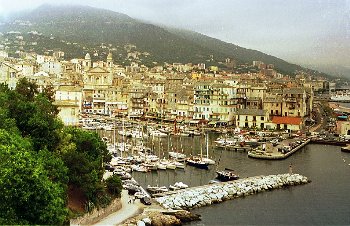
ahead - Cape Corse emerging from the haze. A peninsula of some 40 kms.' length,
stretching out north like an index finger. We sailed along the shore for quite
a while, before calling at the port of Bastia, where the big ferry boats look
somewhat out of place, like in a toy port. Having arrived in Bastia, we first
visit the picturesque old port and afterwards raid a super-market, stocking
up on plenty of delicious French food. Thus provided for, we take off for Cape
Corse or Capi Corsu, as it is called by the Corsicans. Hannes said we would
have to do it at the very start of our trip, since at the end he never had had
time enough to do it...
Land
ahead - Cape Corse emerging from the haze. A peninsula of some 40 kms.' length,
stretching out north like an index finger. We sailed along the shore for quite
a while, before calling at the port of Bastia, where the big ferry boats look
somewhat out of place, like in a toy port. Having arrived in Bastia, we first
visit the picturesque old port and afterwards raid a super-market, stocking
up on plenty of delicious French food. Thus provided for, we take off for Cape
Corse or Capi Corsu, as it is called by the Corsicans. Hannes said we would
have to do it at the very start of our trip, since at the end he never had had
time enough to do it...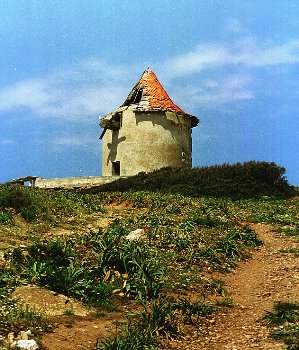 Next
day we continue to the top of Cape Corse, a brief stop at the small fishing
port of Barcaggio. Down south again at the western coast, with the flourishing
vegetation of poppies, buttercups, and daisies constantly delighting our eyes.
And a view of the sea every now and then, of course! At times, we have a little
rest, e.g. at the Mattei mill, standing on a windy peak, and Hannes' about ten
year-old guide-book tells us that this mill has been restored recently and is
now being used as a souvenir shop. Well, we just found a ruin lacking at least
half of its roof and looking quite ruffled and worn away; its delicate-looking
tiles were lying all around, and we could well imagine that it had not resisted
the Corsican storms for too long a time. By the way, I had read that there were
at least seven different Corsican winds, distinguished by direction, temperature
and humidity.
Next
day we continue to the top of Cape Corse, a brief stop at the small fishing
port of Barcaggio. Down south again at the western coast, with the flourishing
vegetation of poppies, buttercups, and daisies constantly delighting our eyes.
And a view of the sea every now and then, of course! At times, we have a little
rest, e.g. at the Mattei mill, standing on a windy peak, and Hannes' about ten
year-old guide-book tells us that this mill has been restored recently and is
now being used as a souvenir shop. Well, we just found a ruin lacking at least
half of its roof and looking quite ruffled and worn away; its delicate-looking
tiles were lying all around, and we could well imagine that it had not resisted
the Corsican storms for too long a time. By the way, I had read that there were
at least seven different Corsican winds, distinguished by direction, temperature
and humidity. 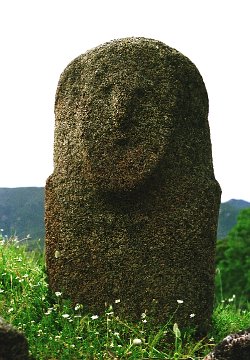 When
we awake, we hear a sound like that of raindrops. Well, it was not really raining
later, but the day would be a grey and cloudy one. We head for Ajaccio, the
circulation there is significantly more dense; we park our car in front of the
Casino, saunter about the old town and the port, passing one of Napoleon's statues.
The Cathedral is just having its roof repaired, which slightly affects its photogenity.
At the port - it's around lunchtime - we do ourselves a favour and have an omelette
with brocciu - Corsican goat's cheese - and a gold-coloured Pietra beer. A final
glance from the mole over the yachts and the fishing port - then off we go -
across the country - to Filitosa: a prehistoric site from Torrean times (some
3000 years old). Menhirs (those huge stones which you all know from the Asterix
comics) with specific drawings (mostly a face at the front and a sword at the
back) and the remnants of foundation walls/settlements - are to be found rather
dispersed around the area. It's a strange feeling to roam around those prehistoric
monuments imagining people having lived there a long, long time ago, to ask
oneself what life might have been like in those days...
When
we awake, we hear a sound like that of raindrops. Well, it was not really raining
later, but the day would be a grey and cloudy one. We head for Ajaccio, the
circulation there is significantly more dense; we park our car in front of the
Casino, saunter about the old town and the port, passing one of Napoleon's statues.
The Cathedral is just having its roof repaired, which slightly affects its photogenity.
At the port - it's around lunchtime - we do ourselves a favour and have an omelette
with brocciu - Corsican goat's cheese - and a gold-coloured Pietra beer. A final
glance from the mole over the yachts and the fishing port - then off we go -
across the country - to Filitosa: a prehistoric site from Torrean times (some
3000 years old). Menhirs (those huge stones which you all know from the Asterix
comics) with specific drawings (mostly a face at the front and a sword at the
back) and the remnants of foundation walls/settlements - are to be found rather
dispersed around the area. It's a strange feeling to roam around those prehistoric
monuments imagining people having lived there a long, long time ago, to ask
oneself what life might have been like in those days...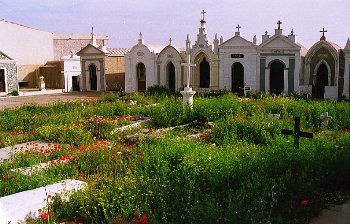 Sometime
or other we return to the present, head for the southern point of the island:
Bonifacio, with its unique location on top of white sandstone rocks (the so-called
Falaises), high above the deep blue sea. We stroll about the upper town, passing
by what used to be the headquarters of the Foreign Legion and by the impressive
Marine Cemetery, where family tombs stand in almost too neat a line - only in
the middle of it all, there seem to be some simple, forgotten graves, overgrown
with a sea of tall red poppies and other plants which to the mortals are only
weeds...
Sometime
or other we return to the present, head for the southern point of the island:
Bonifacio, with its unique location on top of white sandstone rocks (the so-called
Falaises), high above the deep blue sea. We stroll about the upper town, passing
by what used to be the headquarters of the Foreign Legion and by the impressive
Marine Cemetery, where family tombs stand in almost too neat a line - only in
the middle of it all, there seem to be some simple, forgotten graves, overgrown
with a sea of tall red poppies and other plants which to the mortals are only
weeds... 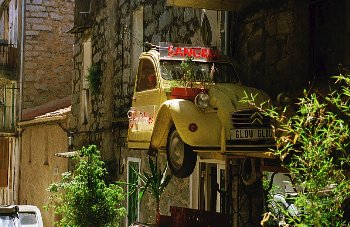 After
another 30 kms.' drive, we reach Porto Vecchio, a cosy little town with a main
square full of bars and bistros, and a row of 2CVs parked in a side alley makes
us even find a 2CV bar: high up in the air, the front half of a 2CV which had
been turned into a pub sign promises "Sangria". Unfortunately, they're
closed at the moment, so we have to drown our regret at another place.
After
another 30 kms.' drive, we reach Porto Vecchio, a cosy little town with a main
square full of bars and bistros, and a row of 2CVs parked in a side alley makes
us even find a 2CV bar: high up in the air, the front half of a 2CV which had
been turned into a pub sign promises "Sangria". Unfortunately, they're
closed at the moment, so we have to drown our regret at another place.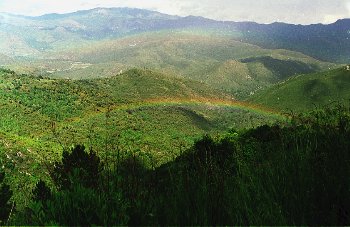 On
the next morning, there is thunder and lightning and rain, and so we only get
up around 10 o'clock. Shortly before noon, we leave our sleeping place in the
woods, heading north along the coastline till Ghisonaccia, where we turn to
the mountains again: through picturesque gorges and by narrow roads, we follow
our way to Corte; at times there is rain, menacing clouds, and then Christe
Eleison Rock stands out against a blue sky. We make a stop somewhere, and I
see a marvellous rainbow right in front of my camera. Finally, we reach Corte.
It's quite chilly up here, and another shower makes us enter a bar, where we
have a bite to eat, in fact sort of a Brocciu pie. Then we stroll along Corte's
old town which seems quite decayed, in a way, offering the charms of decadence.
We climb the road to the Citadel, but it's already closed; there is a lookout
point opposite (Belvedere), with a view of the Citadel rock as well as Tavignano
and Restonica valleys.
On
the next morning, there is thunder and lightning and rain, and so we only get
up around 10 o'clock. Shortly before noon, we leave our sleeping place in the
woods, heading north along the coastline till Ghisonaccia, where we turn to
the mountains again: through picturesque gorges and by narrow roads, we follow
our way to Corte; at times there is rain, menacing clouds, and then Christe
Eleison Rock stands out against a blue sky. We make a stop somewhere, and I
see a marvellous rainbow right in front of my camera. Finally, we reach Corte.
It's quite chilly up here, and another shower makes us enter a bar, where we
have a bite to eat, in fact sort of a Brocciu pie. Then we stroll along Corte's
old town which seems quite decayed, in a way, offering the charms of decadence.
We climb the road to the Citadel, but it's already closed; there is a lookout
point opposite (Belvedere), with a view of the Citadel rock as well as Tavignano
and Restonica valleys.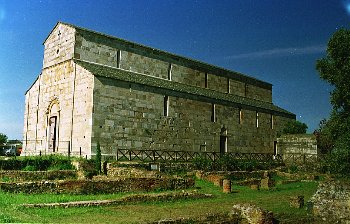 Our
journey is slowly drawing to a close, and we still want to drive through the
Castagniccia, a region that once lived by the sweet chestnut. Soon after the
coastline, there are hills again, even though they are not quite as high. We
enjoy the different views: of a little town, a reservoir... An old mineral cure
health resort is evidently being restored, we just find sort of a building site.
The ruins of a monastery (described by our 'Guide Michelin' which is already
a bit advanced in years) are closed meanwhile because they're unsafe. At Ponte
Leccia, we turn towards the coast again, and we do our last shopping in Bastia.
Then we drive along the lagoon of Biguglia up to the famous Canonica, a Romanesque
church and ancient cathedral, which nowadays is standing more or less in the
open. Next to it, there are still some foundation walls and columns. Opposite,
they are just putting up a fairground, and the noise does not really suit the
atmosphere. There is an outstanding campground nearby, so that we can listen
to the roar of the sea before we fall asleep. It's our last night in Corsica...
Our
journey is slowly drawing to a close, and we still want to drive through the
Castagniccia, a region that once lived by the sweet chestnut. Soon after the
coastline, there are hills again, even though they are not quite as high. We
enjoy the different views: of a little town, a reservoir... An old mineral cure
health resort is evidently being restored, we just find sort of a building site.
The ruins of a monastery (described by our 'Guide Michelin' which is already
a bit advanced in years) are closed meanwhile because they're unsafe. At Ponte
Leccia, we turn towards the coast again, and we do our last shopping in Bastia.
Then we drive along the lagoon of Biguglia up to the famous Canonica, a Romanesque
church and ancient cathedral, which nowadays is standing more or less in the
open. Next to it, there are still some foundation walls and columns. Opposite,
they are just putting up a fairground, and the noise does not really suit the
atmosphere. There is an outstanding campground nearby, so that we can listen
to the roar of the sea before we fall asleep. It's our last night in Corsica...|
URL: http://entenreisen.kretschy.at/corsica.php Stand: 18.04.2024 Copyright: Eva Kretschy<Eva.Kretschy@gmail.com> |